
Préférences
By clicking “Accept all cookies”, you agree to the storing of cookies on your device to enhance site navigation, analyze site usage, and assist in our marketing efforts, as outlined in our Privacy Policy.


By clicking “Accept all cookies”, you agree to the storing of cookies on your device to enhance site navigation, analyze site usage, and assist in our marketing efforts, as outlined in our Privacy Policy.
February 16th, 2026
What We Know and What It Reveals.
On Thursday, February 12, 2026, the CIA released a Mandarin-language video on YouTube aimed at recruiting informants in China, targeting in particular profiles connected to the military and to sectors considered strategic (intelligence, diplomacy, the economy, science, and technology). Beijing responded the next day, promising to take “all necessary measures” against foreign espionage attempts. The episode fits into a long-standing rivalry between the United States and China, in which intelligence plays a central role.
The video features a fictional Chinese officer, portrayed as disillusioned. The message is explicit: if you have information about leaders or senior officers, or if you work in (or operate around) sensitive fields, the CIA invites you to contact it. This approach is notable because it is public, openly acknowledged, and is as much a communications operation as it is a recruitment effort.
The core of the video is not technical; it is a narrative. It shows the officer in a family setting, then in an environment shaped by controls and tension. He claims to have realized that leaders protect their own interests, and that the system rests on lies. The conclusion aims to turn a risky decision into a “moral” act: he says he is choosing this path to fight for his family and his country.
In other words, the video follows a classic communications logic: a character, a conflict (corruption / injustice), a trigger (disillusionment), then an “outcome” presented as rational and almost honorable. It is also a way to lower the psychological barrier: the message does not only say “give information,” it offers a justification.
This release comes at a time when the issue of corruption within China’s military apparatus is widely discussed, with removals and disciplinary investigations reported by the international press. For an intelligence agency, this kind of climate can be seen as a moment of opportunity: frustration, fear, internal rivalries, and uncertainty can make certain profiles more receptive. It is not possible to publicly measure the effectiveness of this release, but the context helps explain why it is being launched now.
The CIA claims it can be contacted “securely” via a hidden service accessible on Tor. In public messaging, this kind of mention serves two functions: to reassure potential candidates (without providing detailed explanations) and to send a political message to Beijing—an assertion of determination despite control and censorship mechanisms.
Looking through the CIA’s YouTube channel, it becomes clear that this Mandarin-language video is not a first attempt. Similar content targeting China has been published for about a year. This new release therefore fits into a now clearly identifiable series: it is the fifth video devoted to China, and most have accumulated tens of millions of views.
A comparable logic can also be found in other videos aimed at different countries or audiences (notably Russia, North Korea, or the Arab world). The format may vary, but the mechanism remains consistent:
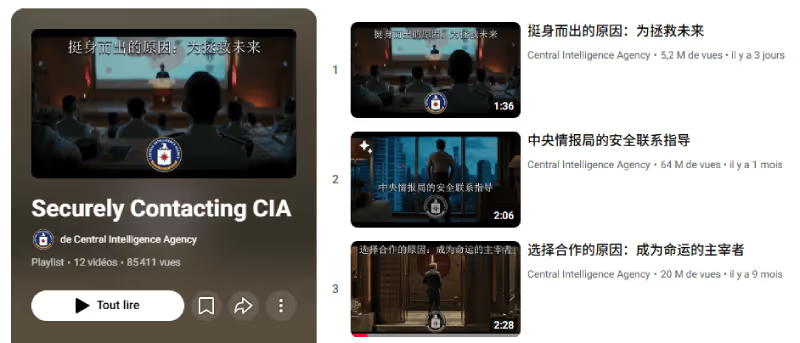
This repetition suggests a long-term logic: tailoring the narrative to each audience, normalizing the public appeal, and multiplying points of entry—more of a communications strategy than a one-off “move.”
China said it would take “all necessary measures” to counter infiltrations and destabilization attempts from abroad. This type of response generally aims to deter internally (by emphasizing the risks) and to project a posture of firmness externally.
In this standoff, information is also a battleground: each side seeks to show that it is holding the line, that it is watching, and that it can respond.

With this Mandarin-language video, the CIA is not only trying to recruit; it is publicly embracing a strategy and testing targeted messaging built around a narrative of corruption and disillusionment.
The last sentence shown on screen—“The fate of the world is in your hands”—encapsulates this staging: turning a clandestine approach into a choice presented as “necessary.”
China’s reaction underscores that these operations are part of a long-term competition, in which influence and intelligence are inseparable from diplomacy.
Source :
AGOP is a Swiss private investigation agency based in Geneva.


.svg)