
Préférences
By clicking “Accept all cookies”, you agree to the storing of cookies on your device to enhance site navigation, analyze site usage, and assist in our marketing efforts, as outlined in our Privacy Policy.


By clicking “Accept all cookies”, you agree to the storing of cookies on your device to enhance site navigation, analyze site usage, and assist in our marketing efforts, as outlined in our Privacy Policy.
February 9th, 2026
Definition, Stakes, and Key Applications.

In a world saturated with sensors, satellites, and algorithms, human intelligence nevertheless remains at the core of intelligence collection. HUMINT (Human Intelligence) refers to information obtained through human sources: through interaction, observation, and understanding context. Where technical tools produce signals and data, HUMINT often provides what is most lacking: meaning, intent, and nuance.
In this article, you will understand what HUMINT is, why it remains central even in the age of AI, what forms it can take, and how it applies today to both cybersecurity and competitive intelligence.
HUMINT stands for Human Intelligence—i.e., “intelligence derived from human sources.” Concretely, it refers to information obtained from people: what they know, what they have seen, what they understand, or what they reveal—intentionally or not.
HUMINT therefore covers everything related to human interaction and observation: interviews, exchanges, collection of testimonies, on-the-ground presence, and leveraging the context that human actors can provide. It makes it possible to access elements that are difficult for sensors to capture: motivations, relational dynamics, internal constraints, unspoken factors, and real priorities.
Conversely, electronic interception, imagery, analysis of large volumes of data, or collection via sensors fall under other categories (technical intelligence). These disciplines are valuable, but they are not HUMINT in the strict sense. In practice, they often complement each other: technical data can raise a question, and a human source can explain the “why.” As we will see later, ROEM (electromagnetic intelligence) is not HUMINT, but it is often presented alongside it because exploiting technical signals depends largely on human analysis and cross-checking.
Concrete example: collecting a witness statement or understanding an account from a key actor falls under HUMINT. In a more institutional context, it can also refer to an ongoing relationship with a source who has access to strategic information—the essential point always being the human dimension of intelligence (and not a technical device).
Important point: HUMINT is not synonymous with “illegal manipulation” or “ruleless spying.” It can be practiced within defined and regulated frameworks (institutional or organizational), but there are also abusive or illegal uses that fall outside any responsible approach. This is precisely why the notions of limits, proportionality, ethics, and cross-checking are central.
AI excels at processing enormous volumes of data, but it does not “understand” intent the way a human does. Models detect patterns, correlations, anomalies. But they do not naturally perceive what often makes the difference: a personal interest, an internal constraint, a rivalry, a fear, a shift in posture, or an unspoken factor that reshapes the entire analysis.
Humans, by contrast, connect the pieces. They pick up weak signals: a slight inconsistency between what is said and how it is said, a detail deliberately avoided, a change in attitude, an overly perfect rationalization. In an economic or operational environment, these micro-indicators can reveal a risk or an opportunity before they appear in formal reports.
Finally, there is the question of decision-making. AI can help prioritize, propose, estimate. But it does not assume responsibility for an arbitration. When multiple hypotheses are plausible, it is the human who must decide while taking into account context, consequences, and ethical limits. The algorithm calculates; the human judges.
Imagine a tool detects unusual movement: hiring, changes in suppliers, increased activity around a specific topic. AI indicates what is happening. Human intelligence (an exchange, field feedback, a cross-checked testimony) can indicate why it is happening—and that “why” often changes the decision.
In other words, AI can accelerate analysis. But HUMINT remains one of the most effective ways to turn data into actionable understanding.
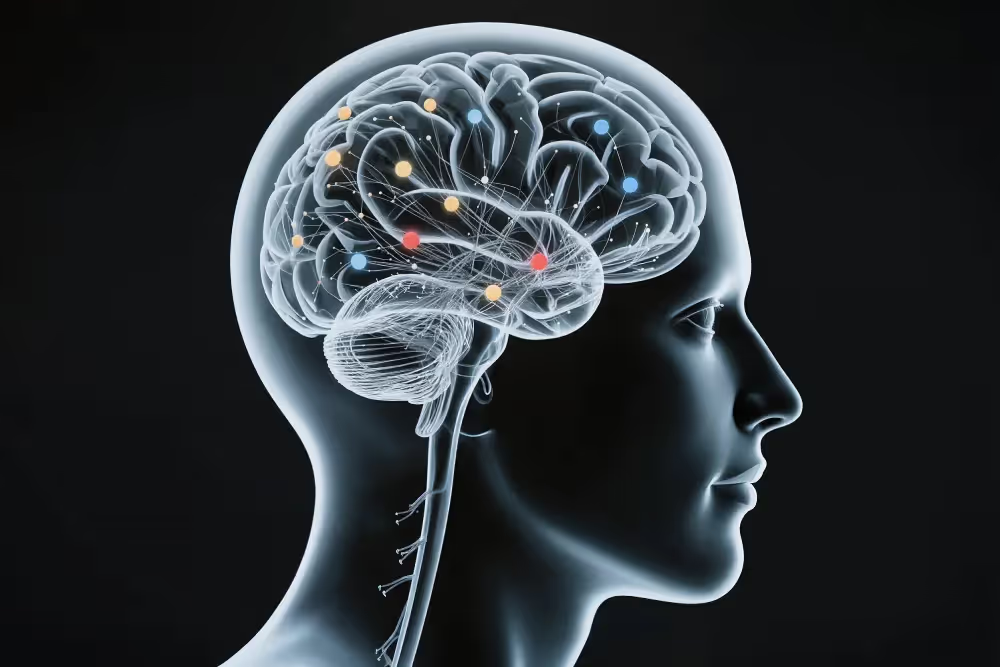
HUMINT is not limited to a single method. Identifying the main “human” channels helps clarify what human-source intelligence actually covers—and avoids two common confusions: believing that a human source necessarily tells the truth, or conflating HUMINT with technical intelligence.
These are individuals placed within a closed or sensitive environment in order to observe, listen, and relay information from the inside. This channel can provide elements that are impossible to obtain otherwise, particularly regarding internal dynamics, intentions, and a group’s real priorities.
Its major limitation lies in the risks: exposure, the agent’s safety, and the possibility of being manipulated or “turned.”
Informants provide privileged access to firsthand information, often because they hold a useful position or because they know a milieu well. The relationship is generally managed and structured (in a state context, by a case officer), which makes it possible to track how a situation evolves over time.
The main limitation is reliability: personal motivations, financial interest, a desire to please, or attempts to steer the analysis.
This channel is based on exchanges with individuals who have been exposed to a situation: travelers, witnesses, involved persons, or field actors. The debriefing first aims to obtain factual information, then to analyze it and compare it with other elements to verify consistency.
Its limitation lies in subjectivity: imperfect memory, reconstruction, emotions, perceptual bias, or rumors relayed as facts.
Observing on site makes it possible to collect concrete, contextualized information that is often more reliable than a secondhand account. It is also a way to understand interactions, rhythms, habits, and environments.
The limitation relates to access to the field, the time available, and above all the risk of interpretation: without cross-checking, a visible detail can be overvalued or misunderstood.

ROEM (communications interceptions, signals, technical traces) is not HUMINT in the strict sense, because the source is not a person but a technical stream. However, it is often presented alongside HUMINT in certain overviews because exploiting this data depends largely on human analysis: interpreting, contextualizing, linking to intentions, and cross-checking with information from human sources. In other words, technical intelligence captures information, but without human interpretation, it often remains difficult to use.
Fundamental principle: no single source is sufficient on its own. Cross-checking, overall coherence, and confrontation of information remain the basis of truly actionable intelligence.
In HUMINT, trust is neither a “talent” nor a dramatic moment. It is a process. It is built over time through consistency, presence, and the quality of exchanges—and above all, it serves to make information possible.
The first reality, often counterintuitive, is simple: trust is built through accumulation. The more you multiply relevant interactions (without forcing), the more you increase your chances of meeting the right people at the right time. This is not a magic formula; it is a logic of probability and network effects.
Then there is relational ease. People speak more readily when they feel understood, respected, and safe. Relational mechanisms (pace, posture, listening, understanding the framework) do not need to be “manipulative”; they can simply be conditions for proper communication. The goal is not to pry information out, but to create an exchange that makes context possible.
But one mental rule must be kept in mind: trust never equals automatic truth. A person can be mistaken, influenced, repeating a rumor, or defending an interest. Trust opens a door; it does not validate anything on its own.
A mainstream example: an executive shares an industry “trend” during regular exchanges. That is valuable because it sheds light on their perception and environment. But it is not necessarily accurate or complete. The value comes when you cross-check, compare, and contextualize.
Trust is therefore an access lever. Reliability, by contrast, depends on critical work.
When information comes from a human, it is never “raw.” It arrives filtered—through memory, emotions, social position, and sometimes an agenda. That is normal. And that is precisely what makes cross-checking indispensable.
A source can be mistaken without any ill intent. Memory reconstructs more than it records. Stress distorts, emotion selects, attention forgets details. Rumor often emerges this way: one person passes on something they believe to be true, and then each relay adds its own interpretation.
It is the same mechanism as in the “telephone game”: a detail changes with each transmission, sometimes without any ill intent. In the end, the story seems coherent, but it no longer has much to do with the initial fact.
A source can also distort. Not necessarily by lying: sometimes to protect their reputation, avoid conflict, be helpful, or provide what they think is expected. The result is that the information is “coherent,” but it is biased.
And sometimes, the information is deliberately instrumentalized. Disinformation, a false lead, a prepared narrative: the human channel can be used to influence a decision. The danger is that the information appears credible precisely because it comes through a relationship.
Never rely on a single human source. Compare multiple accounts, verify what can be verified, and look for inconsistencies before incorporating information into a decision.
Simple example: an employee claims that a colleague is “doing something abnormal.” Maybe they are right. Maybe they are in conflict. Maybe they are extrapolating from a detail. Without validation, you risk acting on a biased reading—with negative consequences.
HUMINT is valuable, but it requires discipline: context, caution, and critical thinking.

In cybersecurity, a technical alert is not always enough to explain what is happening. The same signal can correspond to different intentions: testing, opportunism, targeted reconnaissance, a serious attempt. And it is often an understanding of the actors and the context that makes it possible to prioritize correctly.
The challenge is to turn an indicator into understanding. Technical data says that something is happening. Human reasoning helps answer: who, why, now, and with what likely objective. This approach is not “hacking,” but analysis: understanding an ecosystem, behaviors, and motivations.
The “field” also exists online: communities, networks, communication codes, reputation, and the credibility of certain information. In digital environments, humans remain indispensable for interpreting what circulates, identifying what is serious, and distinguishing hype from a real threat. Here again, caution comes first: contextualizing is not validating.
This understanding has a very concrete impact: better prioritization, more accurate internal communication, risk anticipation, and faster decision-making. In practice, HUMINT and technical capabilities reinforce each other: technology detects, humans interpret, and the organization decides.
HUMINT therefore complements automated tools and AI: it does not replace them. It adds a strategic layer to what would otherwise remain a sequence of signals.
HUMINT does not rely on “mystical” intuition. It is built on skills that can be developed, and above all on the ability to remain clear-eyed in the face of ambiguity.
Knowing how to listen in order to understand, not to confirm a hypothesis. Without that, you steer the exchange and create your own biases.
Behaviors only make sense within a specific environment. Without context, it is easy to over-interpret details.
Human-sourced information must be evaluated, compared, and placed within a coherent whole. Without rigor, you become vulnerable to rumor and disinformation.
Pressure, ego, impatience: these factors degrade the quality of analysis. Composure protects the decision.
Information that is poorly reported is unusable. The value of HUMINT also depends on the ability to structure, prioritize, and communicate clearly.
These skills are relevant well beyond intelligence work: they are useful in business, cybersecurity, and crisis management.
In business, a large share of strategic information is not in databases—it is with people. Clients, suppliers, partners, experts, employees, regulators: understanding what they see and what they anticipate can become a decisive advantage.
Field feedback, professional exchanges, ecosystem observations: all of these are useful signals for anticipating developments.
Limitation: rumors, bias, hasty interpretations.
When a situation deteriorates, the most useful information is often local, human, immediate: what is really happening on the ground.
Limitation: stress, incomplete accounts, contradictory perceptions.
Incidents often stem from behaviors: habits, excessive trust, mistakes, blind spots. Understanding the human factor strengthens a security posture, provided privacy and a proportionate framework are respected.
Limitation: if poorly framed, this approach can drift into unnecessary monitoring or produce faulty conclusions (looking for a “culprit” instead of fixing weaknesses).
Understanding an interlocutor’s constraints, priorities, and internal dynamics helps improve decision-making.
Limitation: “interesting” information is not necessarily reliable or complete.
Red line: legal and ethical
In business, the use of HUMINT must remain compliant: no identity fraud, no unauthorized access, no pressure. “Effective” collection that lacks legitimacy almost always ends up costing more (legally, humanly, reputationally).
As elsewhere, value comes from complementarity: human sources + data + critical analysis.

HUMINT involves a human relationship, but that relationship does not justify any means. A clear framework does not weaken the discipline; it protects reliability, legitimacy, and the quality of decisions.
Facilitating an exchange is not “manipulating.” By contrast, coercing someone, deceiving them to obtain protected information, or exploiting a vulnerability abusively falls outside a responsible approach.
Impersonating a third party or entering a system without authorization falls into a different category, with potentially criminal consequences.
A source must remain free. Any pressure destroys trust and contaminates the information.
The human channel can be biased, incomplete, or instrumentalized. Cross-checking is non-negotiable.
HUMINT complements technical approaches: it adds context, intent, and nuance where signals remain ambiguous.
Responsible approach
Three simple principles: a legitimate purpose (why are we seeking this information), proportionality (means adapted to the stakes), and traceability (structuring the analysis and owning what is certain, probable, or uncertain).
This framing makes HUMINT more credible, more useful, and more defensible.
When data becomes infinite, what truly matters is the ability to make sense of it. HUMINT rests on a simple idea: understanding the world through what humans know, perceive, and reveal—and turning those elements into an informed decision.
You have seen that HUMINT takes several forms: direct-contact sources, ongoing relationships, testimonies, observation, and hybridization with non-human data. But one principle dominates everything: reliability is never automatic. Cross-checking, contextualizing, and maintaining critical judgment are what separate useful information from illusion.
In the age of AI, HUMINT does not disappear; it sometimes becomes more valuable because it reveals the intent behind the signal. But that strength carries a responsibility: respect limits, avoid drift, and favor a defensible approach.
Information is no longer rare. What is becoming rare is clear-sightedness: listening, understanding, and interpreting without losing sight of what really matters.
AGOP is a Swiss private investigation agency based in Geneva.


.svg)