
Préférences
By clicking “Accept all cookies”, you agree to the storing of cookies on your device to enhance site navigation, analyze site usage, and assist in our marketing efforts, as outlined in our Privacy Policy.


By clicking “Accept all cookies”, you agree to the storing of cookies on your device to enhance site navigation, analyze site usage, and assist in our marketing efforts, as outlined in our Privacy Policy.
December 15th, 2025
Stalking, also known as obsessive harassment, is a growing threat in Switzerland. Cyberstalking and repeated intrusions disrupt the lives of many victims every year.

Following the publication of an RTS report on cyberharassment in Switzerland, it seems necessary to address stalking more clearly and to highlight the risks associated with it. This phenomenon, still often misunderstood, affects many people each year and can have a deep impact on their safety, daily life, and well-being.
But first, what exactly do we mean by stalking—and why is Switzerland just as affected as other countries?
In Switzerland, stalking refers to a series of repeated and unwanted behaviors aimed at contacting or approaching a person against their will. This may include persistent phone calls, text messages, social media messages, emails, as well as surveillance, following someone closely, or repeated physical presence near a person’s home or workplace.
These actions, sometimes spread over months or even years, create a climate of fear and constant alertness for the victim. Stalking goes far beyond simple online harassment. It is intrusive, anxiety-inducing, and potentially dangerous, yet still too often underestimated in Switzerland despite its very real impact on personal safety and daily life.
The situations presented in the RTS program show how victims may live in fear for years, facing perpetrators who are often unknown or difficult to identify, as well as a legal framework that, until recently, struggled to clearly define these acts and prosecute those responsible.
This article aims to clarify the phenomenon, explain its different forms, outline the current legal limitations, and draw attention to the real risks associated with obsessive harassment.

Stalking can be defined as a pattern of repeated, targeted, and intrusive behaviors: constant messages, phone calls, monitoring someone’s movements, creating fake accounts, collecting personal information, implicit threats, or physical presence near a person’s home or workplace.
When this behavior takes place online, it is referred to as cyberharassment or cyberstalking. It may include:
Although often digital, this form of harassment has very real consequences for victims.

Available studies in Switzerland confirm what the RTS report highlights: most victims are women, often young, and frequently targeted for reasons they cannot identify.
Common consequences include:
Harassment may be virtual in form, but its effects are very real.
Data from the Swiss Crime Survey 2022 shows that stalking is a well-established reality in Switzerland, even though it is often underestimated. Over a five-year period, one in twenty people reported being targeted by repeated intrusive behavior.
The phenomenon disproportionately affects women, young adults, and residents of urban areas, where anonymity and digital interactions are more common. The forms of harassment vary widely: constant messages, unwanted contact, physical surveillance, fake accounts, and intrusions into private life.
A particularly concerning point is that more than 64% of perpetrators are known to the victim, often former partners or acquaintances. This significantly increases the psychological impact and sense of threat. Despite this, only 17.5% of cases are reported to the police, often due to difficulties identifying the behavior as legally relevant, lack of institutional support, or minimization by others.
Repetition is a key factor: around 30% of victims experience more than 11 incidents, showing that stalking is rarely an isolated event but rather persistent behavior over months or years.
Statistics reveal significant differences between linguistic regions. Italian-speaking Switzerland shows the highest five-year prevalence (6.2%), followed by French-speaking Switzerland (5.9%) and German-speaking Switzerland (4.6%).
These differences may be explained by several factors:
These variations confirm that stalking affects the entire country, regardless of language or cultural context.

One of the most striking elements of the RTS report concerns a cyberstalker in French-speaking Switzerland who allegedly targeted nearly 250 women over several years.
What is even more surprising is that only a few complaints were considered admissible due to the lack of an appropriate legal framework at the time. The final penalty—five day-fines of CHF 30 for insult—appears completely disproportionate given the scale of the behavior.
This case raises critical questions:
Until 2026, Switzerland had no specific criminal offense covering stalking as a whole, which severely limited intervention options.
Until now, Swiss criminal law did not include a specific offense for stalking. Authorities had to rely on other provisions, such as:
These provisions often failed to capture the full pattern of behavior: repetition, duration, accumulation of acts, and the climate of fear.
Concrete consequences included:
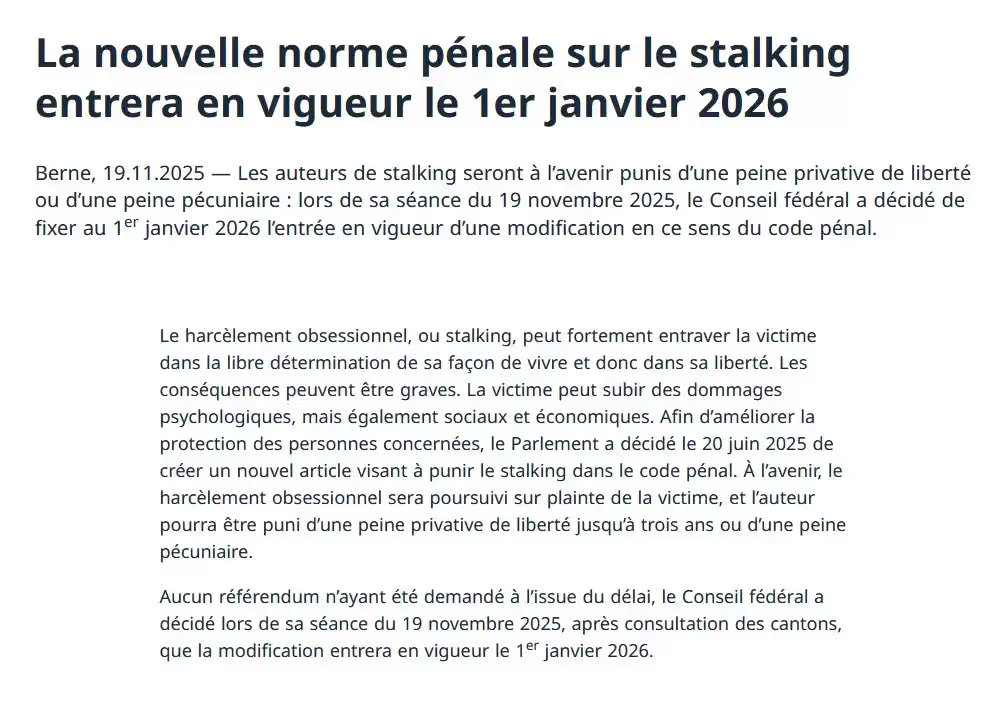
Parliament has adopted a new provision, Article 181b SCC, criminalizing obsessive harassment. Its entry into force is set for January 1, 2026.
The new law provides that:
This represents a major step forward for victim protection and legal clarity. The law sends a clear message: stalking is no longer a minor inconvenience, but a serious violation of personal freedom and psychological integrity.
Even with a legal definition, questions remain:
The law provides a framework, but its effectiveness will depend on training, awareness, and victims’ ability to come forward.
In some cantons, specialized police units occasionally meet identified individuals to assess the risk of escalation. This preventive approach aims to:
This type of intervention falls under preventive policing and can help reduce risks. It is not unreasonable for authorities to seek to understand the mechanisms behind intrusive behavior.
This approach echoes methods used in the United States in the 1970s–1980s, when FBI investigators from the Behavioral Science Unit interviewed violent offenders to analyze behavior patterns, laying the foundations of modern criminal profiling.
However, a fundamental question remains: is this truly the role of the police?
Police monitoring is not therapeutic care. Obsessive behavior usually stems from mental health issues, not judicial ones. Proper support should be provided by psychologists, psychiatrists, or specialized services. Police intervention cannot replace appropriate treatment.
Screenshots, messages, dates, locations, call logs.
Privacy settings, reduced public information.
Family, professionals, specialized organizations.
An official report creates a necessary record.
To understand available protective measures.
In certain cases of stalking or obsessive harassment, a private investigator may assist by documenting facts rigorously, establishing timelines, collecting evidence, and objectively confirming behavior. This material can support a criminal complaint or legal case.
Such intervention must always comply with the law and complement official procedures with the relevant authorities.
Stalking is a form of harassment that is psychological, digital, and sometimes physical. Its impact is deep and often invisible.
The legal recognition of stalking in 2026 is an important step forward, but awareness, victim support, and coordination between institutions remain essential to address this issue effectively.
AGOP is a Swiss private investigation agency based in Geneva.


.svg)