
Préférences
By clicking “Accept all cookies”, you agree to the storing of cookies on your device to enhance site navigation, analyze site usage, and assist in our marketing efforts, as outlined in our Privacy Policy.


By clicking “Accept all cookies”, you agree to the storing of cookies on your device to enhance site navigation, analyze site usage, and assist in our marketing efforts, as outlined in our Privacy Policy.
December 29th, 2025
Infidelity affects many couples in Switzerland and regularly sparks debate, investigations, and media coverage.

Although the topic receives significant media attention, it remains difficult to assess with precision. The figures cited vary widely depending on the sources, data collection methods, and definitions used, making any overall estimate particularly challenging.
Beyond statistics, infidelity primarily reflects complex human realities—marked by doubt, persistent questioning, emotional distress, and sometimes profound relationship breakdowns. In this context, the boundary between intuition and certainty can become blurred, leaving those concerned in a state of uncertainty that is often difficult to endure.
We offer a critical reading of the figures relating to infidelity in Switzerland, analyze the behaviors that fuel suspicion, and recall the applicable legal framework. We also address, in a factual manner, the circumstances under which turning to a private investigator may be considered, in strict compliance with the law.
Surveys and studies published in recent years show highly variable results when it comes to measuring infidelity in Switzerland. This heterogeneity can be explained by several factors: differing methodologies, sometimes unclear definitions of what infidelity actually encompasses, and data collection contexts that may be more or less influenced by the objectives pursued.
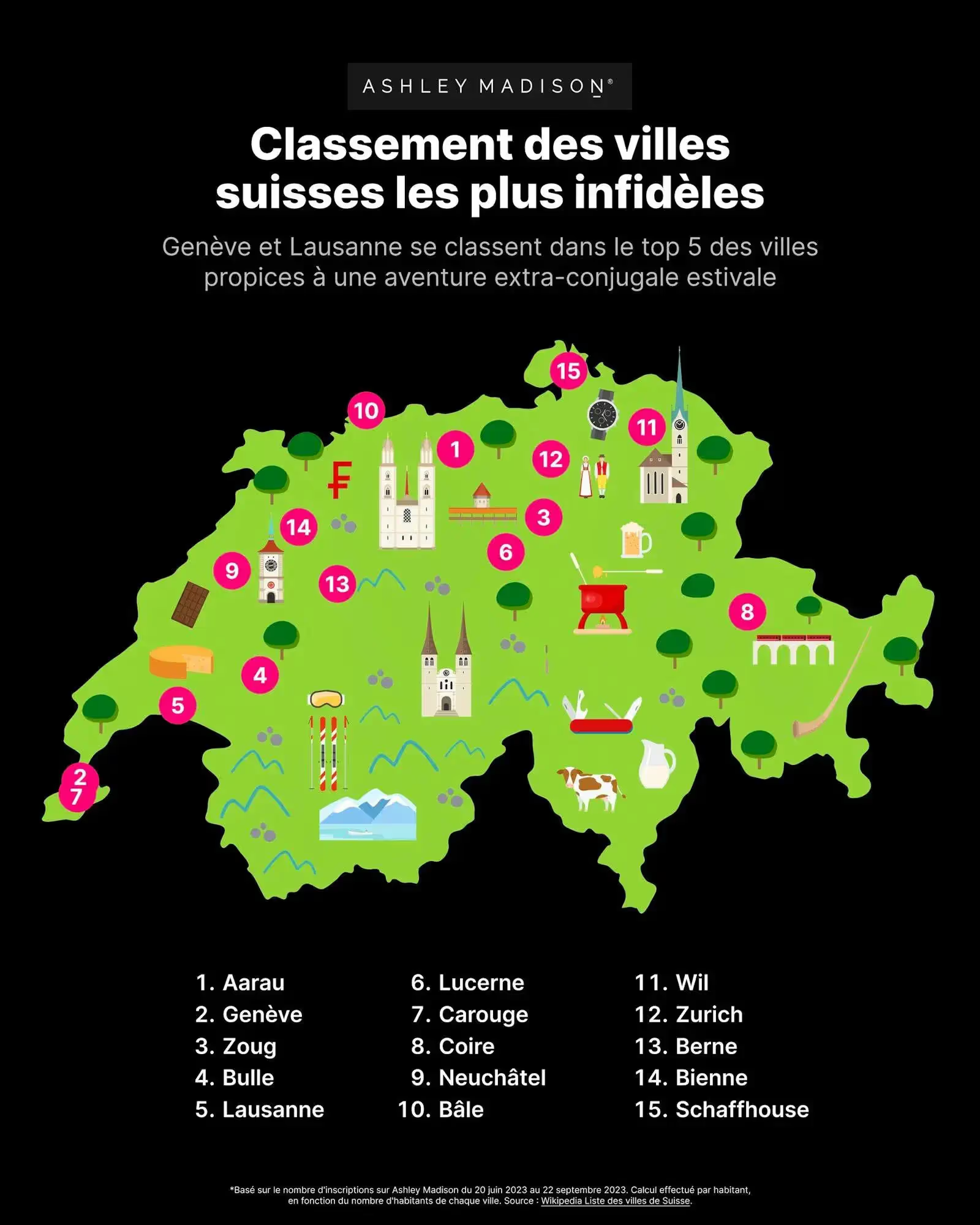
Some figures regularly reported in the Swiss media point to particularly high rates of infidelity, while other studies suggest significantly lower proportions. These substantial discrepancies illustrate how difficult it is to objectively measure a phenomenon that is both intimate and subjective.
The way infidelity is defined plays a decisive role in the responses collected. An exchange of ambiguous messages, a virtual relationship, or a physical relationship are not perceived in the same way by all respondents. Added to this is a major difficulty: answering questions related to one’s intimate life with complete honesty remains sensitive, even within the framework of an anonymous survey.
It is therefore legitimate to question the true reliability of such declarations. Can one reasonably assume that all respondents answered with absolute sincerity? Nothing allows us to assert this.
Moreover, in many cases, essential methodological elements—such as sample size, participant selection criteria, breakdown by gender, age, sexual orientation, or precise geographic scope—are simply not made public. As a result, it is impossible for an external reader to verify the conditions under which these surveys were conducted or to assess their actual reliability.
This lack of transparency calls for caution. The figures presented should be viewed as indicators of trends or perceptions rather than established scientific data, and cannot, on their own, reflect the complex reality of behavior within couples.
Some of the most striking figures circulated in the media originate from surveys commissioned by platforms specializing in extramarital dating. In many cases, however, neither the precise identity of the organizations responsible for conducting these surveys nor the exact conditions under which they were carried out are clearly documented.
These actors have an obvious interest in portraying infidelity as a widespread and pervasive phenomenon. By disseminating high figures, they help normalize such behavior while simultaneously legitimizing their business model and positioning within the extramarital relationship market.
This strategy has proven particularly effective. The results of these surveys are regularly picked up by mainstream media outlets such as RTS, Radio Lac, and free daily newspapers, providing these platforms with significant media exposure. This visibility directly contributes to attracting new users, effectively turning information into a marketing lever.
In this context, certain figures are repeatedly highlighted—often in the form of striking percentages or country rankings—without readers being given the necessary elements to assess their relevance or actual scope. Such data should be understood as communication tools rather than established scientific findings.
Thus, despite being widely relayed, these statistics are more akin to visibility campaigns than to independent sociological studies. They therefore call for a critical reading and a high degree of caution in their interpretation.
Behind percentages and media debates lie, above all, individuals, couples, and unique personal stories. Infidelity is never reducible to a statistical data point. It unfolds within life trajectories, relationships that may be weakened, and complex emotional contexts. It is likely on this point that the gap between figures and lived reality is the most pronounced.

The discovery of infidelity often triggers a major emotional shock. Anger, sadness, incomprehension, and a loss of trust intertwine, sometimes over a prolonged period. For the betrayed partner, it is often the entire perception of the relationship that is shaken, accompanied by a profound sense of questioning.
In the course of our work at AGOP, one word frequently comes up in the voices of those who contact us: betrayal. Betrayal by one’s wife, husband, or partner. This term illustrates the abrupt rupture of the implicit bond of trust that underpins a couple’s relationship, well beyond the purely sexual dimension.
On the side of those who are unfaithful, the situation is rarely experienced as simpler. They may experience conflicting emotions, combining guilt, shame, temporary relief, and personal justification. Contrary to a common belief, infidelity cannot be reduced to a search for sexual gratification alone. It often reflects pre-existing relational vulnerabilities.
Among the triggering factors most frequently mentioned are:
Age also constitutes a triggering factor that is frequently observed. As certain stages of life approach—one’s forties, fifties, or sometimes later—some individuals feel a need to reassure themselves about their power of attraction. The feeling of no longer being desirable, the fear of aging, or of social invisibility can fuel a search for external validation.
In this context, a phase of seduction may develop, sometimes initially in an innocuous manner, before gradually shifting toward an extramarital relationship. Infidelity then becomes less an impulsive act than an attempt at identity reassurance, aimed at confirming that one is still desired, attractive, or capable of eliciting interest from others.
These factors in no way excuse infidelity, but they do help to understand its underlying mechanisms. Above all, they serve as a reminder that adultery rarely follows a simplistic or purely opportunistic logic. It is often the visible symptom of deeper imbalances within the relationship.
Not all forms of infidelity are the same. A one-time lapse, occurring in a specific context, does not have the same consequences as a parallel relationship established over time.
A prolonged extramarital relationship generally involves a greater emotional investment, the organization of deception, and the maintenance of a double life. The injury felt by the partner is often deeper, as the betrayal unfolds over an extended period.

Suspicions of infidelity rarely arise without reason. They most often develop gradually, following repeated changes in a partner’s behavior. Taken in isolation, these elements may seem insignificant. Accumulated over time, however, they can create lasting discomfort and fuel doubt.
Certain signs recur consistently when suspicions arise within a couple. Among the behaviors most often mentioned are the following:
These elements never constitute proof in themselves. They must be interpreted with caution and placed back into their proper context. However, their accumulation can foster a sense of inconsistency and reinforce a persistent discomfort within the couple, giving rise to many questions.
When doubt takes hold within a couple over time, uncertainty often becomes harder to endure than the truth itself. Repeated questioning, the absence of clear answers, and constant assumptions can generate deep anxiety and durably undermine emotional balance.
Clarifying doubt consists of objectively verifying whether suspicions are well-founded or not. It helps move away from a state of constant anxiety and prevents hasty interpretations, which are often driven by emotion rather than facts.
It is no coincidence that, within our agency, we summarize this approach with a simple formula: doubts, answers, evidence. This approach illustrates the very logic of clarifying doubt—starting from a legitimate question, providing concrete elements in response, and relying on verifiable facts rather than assumptions.
This process is primarily intended to distinguish intuition from established reality. Whatever the outcome, it enables informed decisions to be made about the future of the relationship, without remaining trapped in a climate of uncertainty.
Professional observation relies on lawful and discreet methods, such as surveillance or tailing. Its purpose is to document specific facts through detailed reports, photographs, or video footage, in strict compliance with the legal framework.
These factual elements may confirm or refute suspicions. They provide an objective basis that allows for calm personal reflection and, in certain cases, can support subsequent legal proceedings when the circumstances warrant it.
When faced with suspicions of infidelity, some individuals choose to monitor their partner themselves using technological tools readily available to the general public. At first glance, this approach may seem simpler or less costly than turning to a private investigator. However, we strongly advise against it.
Although these practices may appear harmless due to their ease of access, they in fact expose those who engage in them to significant legal risks. While they may seem less expensive than the services of a private investigator specializing in infidelity or adultery investigations, this apparent savings can lead to serious consequences. In certain cases we have already encountered, such behavior has resulted in criminal court proceedings against the individual involved, along with the penalties that follow.
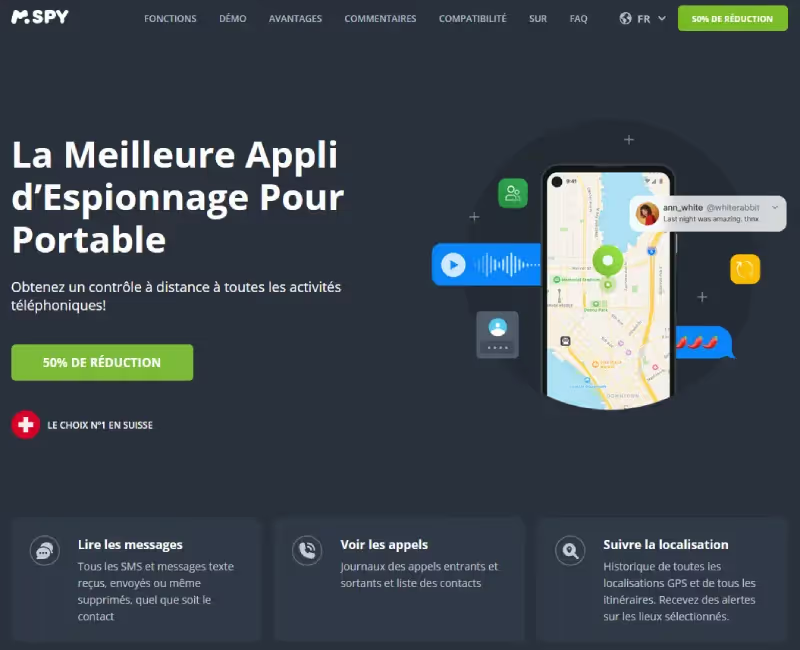
Spy applications, GPS trackers, connected devices, or shared digital accounts now make it possible to monitor a person’s movements, communications, or certain habits. Their widespread availability can sometimes create the illusion that such use is tolerated—or even legal.
However, using these tools without the consent of the person concerned constitutes a serious infringement of privacy. Such practices can quickly go beyond the scope of legitimate suspicion and amount to intrusive surveillance, potentially giving rise to criminal liability for the individual responsible.
In Switzerland, spying on one’s partner without their consent constitutes an infringement of privacy and is strictly prohibited by law. Evidence obtained in this manner is not only inadmissible in court, but its collection may also lead to criminal prosecution.
The distinction between an investigation conducted by a licensed private investigator and personal spying is therefore essential. A private investigator operates within a strict legal framework, using regulated methods and adhering to professional ethical obligations. By contrast, an individual initiative—even when motivated by suspicions of infidelity or personal distress—may place the person involved in an unlawful situation.
Calling on a private investigator is neither an automatic solution nor a trivial step. This option must respond to specific needs and fit strictly within the legal framework. It is generally considered when suspicions of infidelity persist and the person concerned seeks to obtain objective elements, without exposing themselves to legal risks.
The practice of the private investigator profession is subject to specific regulation within the Swiss Confederation in certain cantons, notably Geneva, Neuchâtel, and Ticino. In these cantons, the activity is subject to authorization and registration in an official register maintained by the competent authorities.
By way of example, in the canton of Geneva, private investigators must be listed in a dedicated cantonal register that is publicly accessible. It is therefore essential, before taking any steps, to verify that the private investigator being retained holds the required authorizations and operates in compliance with the applicable regulations.
Although the private investigator profession is not regulated uniformly across all Swiss cantons, compliance with federal law remains imperative. The methods employed must, in particular, ensure the protection of privacy and fundamental rights. Any evidence obtained unlawfully loses its legal value and, as a domino effect, cannot be used either for personal purposes or in judicial proceedings.
Turning to a private investigator may be considered when suspicions of infidelity become persistent and when significant personal, family, or legal issues are at stake. This approach makes it possible to obtain factual and verifiable elements in order to make informed decisions, without crossing the boundaries imposed by the law.
Within the framework of an investigation conducted by a private investigator, findings are based on objective and documented observations. At the private detective agency HAGOP, for example, investigations result in detailed, time-stamped reports that chronologically trace the surveillance or tailing operations carried out.
These reports may be supported by visual elements derived from on-site observations, such as:
These elements, collected in compliance with the legal framework, make it possible to confirm or refute suspicions of infidelity. They provide an objective basis on which the person concerned can rely to consider next steps, whether these involve a personal decision or appropriate legal action.
When an infidelity investigation is being considered, the question of the cost of a private investigator in Switzerland naturally arises. Fees vary depending on several criteria directly related to the nature of this type of assignment.
The cost of an investigation depends in particular on:
In practice, infidelity investigations are most often billed on an hourly or daily basis. In Switzerland, it is generally advisable to anticipate a minimum hourly rate of approximately CHF 100.–, which may vary depending on the specific requirements of the assignment.
When surveillance or tailing is implemented, the budget must be assessed globally. In practical terms, a full day of investigation represents a minimum cost of around CHF 1’000.–. This amount may increase depending on the number of investigators involved, the duration of the operation, logistical constraints, or real-time operational adjustments.
Prior to any intervention, an initial consultation is conducted to define the objectives, assess feasibility, and estimate costs in a transparent manner. This step is essential to avoid any misunderstandings and to ensure that the investigation remains proportionate to the issues at stake.
This preliminary phase necessarily leads to the signing of a written mandate, which legally frames the private investigator’s mission. No investigation should begin without this formalized mandate, which sets clear boundaries for the assignment, protects the client’s interests, and guarantees compliance with the legal framework.
These steps are essential to prevent unforeseen issues, avoid legal pitfalls, and ensure that the approach remains proportionate to the personal or family matters involved.

When doubt becomes too heavy to bear and questions persist, turning to a private investigator can be a considered and well-structured step. AGOP, a private investigation agency based in Geneva, supports individuals facing suspicions of infidelity through a rigorous, discreet approach that strictly complies with Swiss law.
Our investigations are primarily aimed at providing factual and objective elements to help clarify a situation, dispel doubt, or, where appropriate, prepare for important personal decisions. Each assignment is conducted with full respect for privacy, using recognized professional methods and under absolute confidentiality.
If you feel the need to obtain clear answers without exposing yourself to additional legal or emotional risks, we invite you to contact our agency for a confidential, no-obligation discussion.
To date, there are no official, comprehensive, or widely accepted statistics that accurately measure infidelity in Switzerland. The figures most commonly reported in the media mainly come from private surveys, often commissioned by platforms specializing in extramarital dating, such as Ashley Madison.
Due to the lack of transparency regarding the methodologies used — including sample size, study duration, geographic distribution, or selection criteria — these figures should be interpreted with caution. They serve more as indicators of trends or communication tools than as established scientific data.
Switzerland applies the principle of no-fault divorce. Infidelity, in and of itself, therefore constitutes neither legal grounds for divorce nor a criterion for assigning fault to one spouse.
However, facts related to infidelity may have an indirect impact in certain specific situations. When the conduct observed has concrete consequences—for example on the couple’s financial situation, the organization of family life, the allocation of the marital home, or the well-being of the children—the court may take these elements into account as part of the ancillary measures to the divorce.
It is therefore not the evidence of infidelity itself that is decisive, but rather its objective and measurable effects on marital and family life. In this context, only evidence obtained lawfully and documenting concrete facts may, where applicable, be considered by the judicial authorities.
Hiring a private investigator may be considered when suspicions of infidelity persist and it becomes necessary to obtain factual and verifiable elements in order to make informed decisions, whether personal or legal in nature. Such an approach must strictly comply with the Swiss legal framework.
AGOP is a Swiss private investigation agency based in Geneva.


.svg)