
Préférences
By clicking “Accept all cookies”, you agree to the storing of cookies on your device to enhance site navigation, analyze site usage, and assist in our marketing efforts, as outlined in our Privacy Policy.


By clicking “Accept all cookies”, you agree to the storing of cookies on your device to enhance site navigation, analyze site usage, and assist in our marketing efforts, as outlined in our Privacy Policy.
February 2nd, 2026
Key insights to understand what you are really paying for.

Are you considering hiring a private investigator in Geneva and wondering about the real cost of such a step?
This is a perfectly legitimate question, especially when the decision may have a concrete impact on your personal or professional situation.
Contrary to what one might assume, there is no single, fixed rate for a private investigator in Geneva. Each assignment is different and is subject to a prior assessment. As an indication, fees generally fall within a range of approximately CHF 100 to CHF 200 per hour. They then vary according to several factors: the nature of the investigation, its complexity, the time required, the human resources involved, and the equipment used to conduct the investigation under appropriate conditions.
An essential factor must also be taken into account: the Geneva legal framework.
In the Canton of Geneva, only licensed private investigation agencies are authorized to operate. This strict framework provides safeguards for the client, but it also entails specific professional obligations. The fees charged by a private investigation agency in Geneva therefore reflect this legal, ethical, and operational reality.
The objective of this article is straightforward: to provide you with clear and practical reference points to understand how private investigator fees are structured, what is justified, what should raise red flags, and how to avoid unpleasant surprises.
At AGOP, we are convinced that transparency begins with honest information. Understanding pricing is already a first step toward an investigation conducted under the right conditions.

When you look up how much a private investigator costs in Geneva, you quickly come across highly variable rates. Some advertise attractive prices, while others display significantly higher amounts. This sense of uncertainty is common—and perfectly understandable.
As mentioned at the beginning of the article, the fees charged by a private investigator in Geneva are not standardized and vary depending on the nature of the assignment. They generally range between CHF 100 and CHF 200 per hour. In practice, the majority of private investigation agencies apply fees of around CHF 100 per hour per investigator for standard assignments.
These differences are not random; they primarily reflect the nature of the assignment rather than a uniform pricing scale.
One essential point must be clearly understood: a private investigation is never a standardized product.
Each situation is different. A simple information search has nothing in common with discreet surveillance over several days, a sensitive investigation, or an assignment involving multiple operatives. The cost therefore depends less on a “posted price” than on what the investigation actually requires in terms of time, human resources, and operational means.
This is precisely why a serious professional always begins by analyzing your situation before directing you toward an appropriate arrangement. Fees, as well as any potential additional costs, are then defined contractually (mandate agreement) in order to avoid any ambiguity.
The real question to ask, therefore, is not:
❌ “What is the lowest rate?”
But rather:
✅ “What exactly does this rate include, and what professional guarantees does it provide?”
When you consult several private investigators in Geneva, you quickly notice that fees can vary significantly. This difference is never arbitrary. It reflects concrete factors that directly influence how an investigation is conducted—and therefore its actual cost.
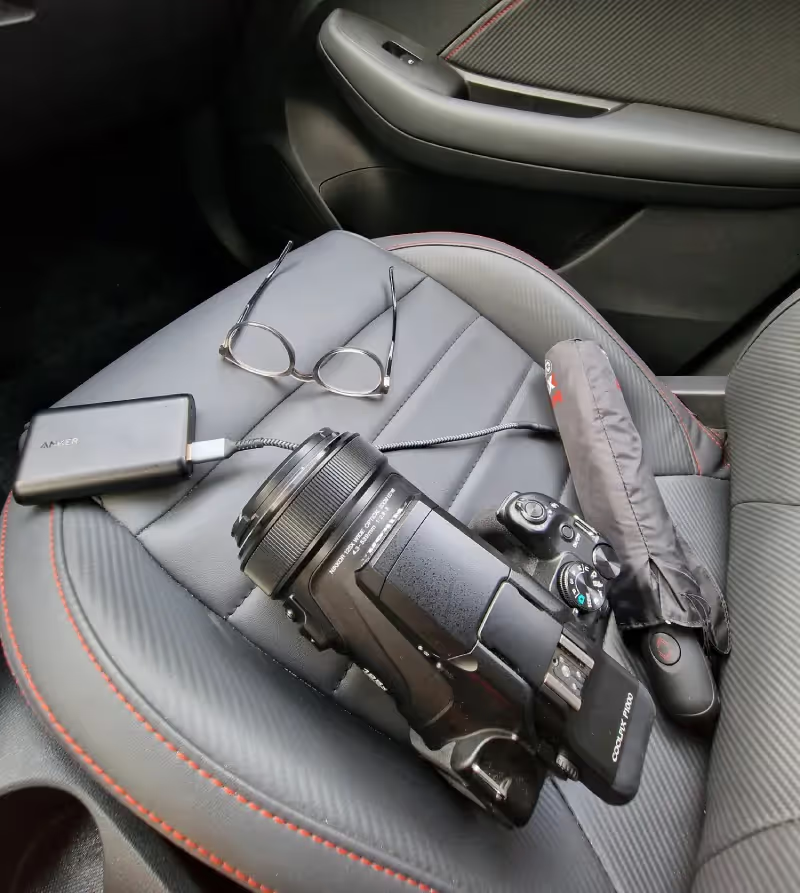
Not all assignments require the same resources.
A simple information or solvency check does not involve the same time commitment or skill set as marital surveillance, a commercial investigation, or an in-depth digital investigation.
Some assignments require specific expertise, such as OSINT or digital data analysis (open-source intelligence). Others demand discreet field presence, sometimes over long and unpredictable periods. The more specialized the methodology, the more the fee is adjusted accordingly.
Unlike a standard service, the duration of an investigation cannot be set artificially.
A surveillance operation may last a few hours—or extend over several days—depending on the behavior, movements, or habits of the person being observed.
Rushing an investigation at the expense of discretion or quality would compromise its results. The time billed therefore corresponds to the time that is genuinely necessary, not to a theoretical estimate.

Some investigations require the simultaneous involvement of several investigators.
In an urban environment, effective surveillance often relies on coordination between investigators to avoid detection and ensure continuity of observation.
This human coordination strengthens the reliability of the investigation, but it naturally affects the overall cost of the assignment.
Operating as a private investigator in Geneva requires compliance with a rigorous legal framework. These rules are not unnecessary constraints; they ensure that the information collected is usable, particularly in a legal or judicial context.
Private investigators specialized in Switzerland, and more specifically in the Canton of Geneva, have in-depth knowledge of administrative frameworks, authorized sources, and lawful investigative methods. This expertise allows them to obtain precise and relevant information by relying on professional tools and specialized software, used in strict compliance with the law and deliberately not disclosed.
A serious professional therefore invests in ongoing training, mastery of procedures, and a methodology that complies with Swiss legal requirements. This level of rigor and compliance is naturally reflected in the fees charged.
Certain assignments inevitably involve additional costs related to field realities. These may include travel expenses, mileage, vehicle rental when the situation requires it, as well as meals and accommodation costs for investigations involving prolonged presence or geographic displacement.
These costs are not arbitrary add-ons, but operational expenses that are essential to the proper conduct of the investigation. They must always be clearly disclosed, explained, and transparently integrated into the financial framework defined with the client.
It is also important to specify that a professional private investigator does not apply artificial distinctions between interventions carried out on weekdays, at night, or on weekends. The investigation adapts to the constraints of the situation, without any opportunistic surcharge logic.
An abnormally low fee most often reflects a lack of professionalism, insufficient methodology, or an attempt to artificially compress the costs of an investigation.
In this profession, there are no “promotional offers” or “discount sales.” A serious investigation requires human resources, time, expertise, and real legal responsibility. Excessively reducing fees often means sacrificing quality, reliability, or legality—ultimately to the client’s detriment.
We address this point in greater detail later in the article, to help you distinguish a serious fee structure from potentially misleading practices.

There is no universal billing method in private investigations. The choice primarily depends on the nature of the assignment, its level of uncertainty, and the objectives pursued. A relevant billing structure is one that truly matches the situation, not the one that merely appears most reassuring on paper.
Hourly billing consists of charging only for the time actually devoted to the investigation. This approach is particularly suited to exploratory assignments, evolving situations, or interventions whose duration cannot be determined in advance.
Advantages:
Limitations:
In this context, regular communication and prior agreement on financial limits remain essential.
A flat fee provides a global amount for a clearly defined assignment. It is suitable for investigations with a precise scope, targeted surveillance, or specific checks whose parameters are clearly established from the outset.
This is notably the case for residency verification assignments, for which the objectives, methodology, and time frame are known in advance. In this type of mission, a flat fee is an appropriate and straightforward solution. It is also the billing method we favor at AGOP for this kind of intervention.
This approach offers valuable budgetary visibility. However, it assumes that the assignment does not undergo any major changes along the way. As soon as the parameters shift, an adjustment becomes unavoidable.
A flat fee therefore remains relevant when the scope of the intervention is fully controlled from the start.
Many private investigation agencies in Geneva offer personalized estimates, sometimes combining several billing methods. When done properly, an estimate specifies the objectives, the means envisaged, an estimated duration, and the associated financial terms.
This approach may be suitable for certain situations, particularly when the phases of the investigation can be clearly identified in advance. In practice, however, such estimates are based on assumptions, as an investigation is by nature subject to change.
At AGOP, we have chosen not to offer generic online estimates. Not in opposition to the principle of an estimate itself, but because our experience shows that such preliminary assessments rarely reflect the actual cost of an investigation once it is underway.
Each case presents its own constraints, unforeseen elements, and necessary adjustments. A serious assessment therefore requires an in-depth discussion in order to define a realistic and appropriate framework, rather than producing an approximate estimate that risks losing relevance as the investigation progresses.
Some surveillance assignments require the simultaneous deployment of several private investigators. This is particularly the case for tailing operations in dense urban environments, prolonged surveillance, frequent movements, or situations where discretion requires regular handoffs between investigators.
In these situations, using multiple investigators is not a matter of convenience, but an operational necessity. It significantly reduces the risk of detection, ensures continuity of surveillance, and improves the reliability of field observations.
Working in pairs—or with a larger team—addresses very concrete constraints specific to field investigations:

From a methodological standpoint, surveillance conducted by two investigators is often more effective and more discreet than a prolonged operation carried out by a single investigator. In many cases, this organization can even shorten the overall duration of the assignment.
In terms of pricing, two approaches coexist among private investigation agencies in Geneva and Switzerland:
Some agencies, for example, apply a full rate for the first investigator and a reduced rate for the second (for instance, CHF 100 per hour for the first investigator and CHF 90 per hour for the second). This approach is intended to make an operationally more demanding human and organizational setup economically acceptable.
This is neither an automatic rule nor a generalized practice, but rather a professional option usually reserved for assignments that genuinely justify the presence of multiple investigators.
A setup involving multiple investigators does not necessarily mean a higher final cost. In some cases, a mission carried out by two investigators makes it possible to obtain results more quickly, with a lower total number of billable hours than a prolonged surveillance conducted by a single investigator.
The key factors are therefore not the number of investigators deployed, but rather:
A serious agency will always explain why multiple investigators are necessary and how this organizational choice concretely serves the client’s interests.
Using multiple investigators must remain a strategic decision, never a commercial one. When justified, it strengthens the reliability and discretion of the investigation. When it is not, it unnecessarily increases costs.
A professional approach therefore consists of adapting human resources to the realities of the field—rather than imposing a standardized setup. It is this ability to conduct a prior analysis that distinguishes a methodical agency from a purely quantitative approach.

The posted price never tells the whole story. A fee may appear attractive while concealing substandard work, just as a higher amount may reflect a rigorous methodology and legally usable results.
What truly matters is the consistency between the proposed fee, the investigative method, the resources deployed, and the legal framework within which the agency operates.
A serious private investigator always begins by defining the scope of the assignment. Before any intervention, you should understand what will be done, how it will be carried out, and within what limits.
Depending on the agency, this may take the form of a written estimate or a detailed proposal resulting from an in-depth discussion. In all cases, the essential elements must be clearly set out:
A credible professional will also require you to sign a written mandate, accompanied by clear general terms and conditions. They never promise guaranteed results: private investigations are based on factual findings, not on outcomes claimed in advance.
Certain practices should immediately raise concerns. An abnormally low fee without a clear explanation, or an overly reassuring sales pitch, are rarely good signs.
Here are the main red flags:
When one or more of these warning signs are present, there is a real risk that the investigation will be conducted without rigorous methodology, resulting in fragile or difficult-to-use findings.
A poorly conducted investigation often leads to serious consequences: loss of time, unnecessary expenses, and sometimes the inability to assert one’s rights afterward. Evidence obtained outside the legal framework does not strengthen a case—it weakens it.
A private investigator’s fee primarily reflects the actual time devoted, the expertise mobilized, and the resources required to conduct a compliant and usable investigation. A serious professional keeps the client regularly informed of the progress of the assignment and the costs incurred, without unpleasant surprises.
The first contact is often telling. A professional private investigator asks precise questions, explains legal limitations, adjusts the scope of the assignment if necessary, and never encourages unnecessary expenses.
This initial dialogue is primarily intended to protect the client’s interests—and is often the best indicator of an agency’s professionalism.
When you compare the fees of a private investigator in Geneva, you see numbers—between CHF 90 and CHF 250 per hour depending on the agency. But these figures tell only part of the story.
A private investigation is not a standardized product. Two services advertised at the same price can have radically different value. The hourly rate reflects neither the quality of the work, nor its legality, nor its actual effectiveness.
What the price does not show:
These elements make all the difference between a useful investigation and a waste of time. Yet they never appear on a line item in a quote.
Consider two investigations billed at CHF 100 per hour. The first accumulates hours without a clear strategy. The second follows a precise methodology from the outset. The result: the first produces unusable evidence. The second saves you from having to start over.
The true cost of an investigation is measured over time, not by the hour.
We observe that a serious investigation begins before fieldwork. Analysis always takes precedence over the accumulation of hours. The Swiss legal framework imposes strict and non-negotiable limits that some choose to ignore.
In private investigations, it is not the rate that creates value, but what the professional does with it.

At AGOP, every assignment begins with a step we consider essential: analysis. We take the time to listen to your situation, understand the context, and identify the real issues before any field action. This preliminary phase allows us to define a strategy tailored to your specific case.
From our initial contact, we explain what is legally possible—and what is not—under Swiss law. Together with you, we define realistic objectives and the limits of the investigation.
This exchange phase makes it possible to establish a clear framework: the resources envisaged, estimated timelines, and financial terms. There is no lack of transparency—you know exactly what is being committed and why.
We reject standardized investigations. Each case receives individual attention and a tailored strategy. Depending on your needs, we deploy a team of experienced investigators or assign a single private investigator, in Switzerland as well as internationally.
Technical and human resources are proportionate to the complexity of your case. This proportionality ensures both the effectiveness of the investigation and cost control.
A private investigation entails our professional responsibility. The information we collect must be usable, defensible, and clearly presented. Our reports are drafted with rigor, in respect of the individuals concerned and in compliance with the legal framework.
At our private investigation agency in Geneva, pricing is never reduced to a mere number: it reflects a methodology, a strict legal framework, and a genuine professional commitment.
The issue of pricing cannot be separated from the framework within which an investigation is conducted. Private investigator fees in Geneva primarily reflect a working methodology, the resources deployed, and clearly assumed professional responsibility.
Each assignment has its own specific characteristics. A one-time surveillance does not require the same resources as an investigation involving multiple investigators or specialized technical expertise. The cost of an intervention results from these methodological choices, not from an arbitrary or standardized pricing scale.
A low price guarantees neither effectiveness nor legal compliance. Conversely, a higher fee only makes sense if it is based on a serious analysis of your situation and on resources that are genuinely suited to the objectives pursued.
An agency’s commitment is measured by its ability to:
The initial exchange is a decisive step. It makes it possible to establish a precise framework, define realistic objectives, and ensure that the method employed corresponds to the reality of your situation.
In this process, pricing is never an end in itself. It reflects a professional commitment founded on discretion, rigor, and respect for a strict legal framework. Before comparing prices, it is essential to understand what they truly encompass.
AGOP is a Swiss private investigation agency based in Geneva.


.svg)