
Préférences
By clicking “Accept all cookies”, you agree to the storing of cookies on your device to enhance site navigation, analyze site usage, and assist in our marketing efforts, as outlined in our Privacy Policy.


By clicking “Accept all cookies”, you agree to the storing of cookies on your device to enhance site navigation, analyze site usage, and assist in our marketing efforts, as outlined in our Privacy Policy.
January 12th, 2026
Hiring a private investigator in Geneva involves one essential requirement: holding the legal authorization to practice.

In the Canton of Geneva, the private investigator profession is strictly regulated and subject to official registration with the competent authorities.
Many people are still unaware that an official list of licensed private investigators in Geneva exists, maintained by the Brigade of Weapons, Private Security and Explosives (BASPE). This list is the only reliable reference for verifying that a professional is legally authorized to operate in the canton.
In this article, we provide a clear, lawful, and up-to-date guide explaining where to find this official list, the conditions required to be authorized to work as a private investigator in Geneva, the services that may be offered within a legal framework, and how to safely choose a licensed professional.
In Geneva, the practice of the private investigator profession is strictly regulated. The only official reference allowing verification of whether a private investigator is legally authorized to operate in the Canton of Geneva is the list maintained by the Brigade of Weapons, Private Security and Explosives (BASPE), which operates under the Geneva Cantonal Police.
This list includes all licensed private investigators and investigation agencies that have been authorized following a review of their integrity, administrative status, and compliance with the applicable legal requirements.
It is public, regularly updated, and freely accessible.
Consulting this list is an essential step before any initial contact or the signing of a mandate. A private investigator who does not appear on this list is not legally authorized to operate in the Canton of Geneva, regardless of their commercial claims or stated experience.

The official list of authorized private investigators is available directly on the Geneva Cantonal Police website, via the dedicated BASPE page. It is generally provided in the form of a downloadable document.
This document allows you, in particular, to verify for each authorized private investigator or investigation agency:
This simple verification step helps avoid engaging an unauthorized intermediary, whose actions could expose the client to significant legal risks.
Hiring an unauthorized private investigator can have serious consequences. The evidence collected is not only inadmissible, but it may also expose the client to criminal or civil liability.
Conversely, a private investigator listed on the official register is authorized to operate within a clear legal framework, using regulated methods and adhering to strict professional and ethical obligations. This ensures not only the legality of the investigation, but also the admissibility of the findings in judicial or administrative proceedings.
Last updated: September 24, 2026
An analysis of the official list of licensed private investigators in Geneva—compiled from the cantonal register and regularly updated—makes it possible to accurately understand and assess the evolution and structure of the profession within the Canton of Geneva.

In total, 400 distinct private investigators are currently listed as having been granted authorization to practice in Geneva since the establishment of the register.
Each entry in the register corresponds to an individual authorization, regardless of any family or business relationships, or the possible sharing of the same professional address.
This volume reflects a sustained and long-standing level of activity within the profession over several decades, with authorizations being issued continuously from the 1960s through to the present day.
A chronological review of authorization dates shows that:
These trends confirm that the private investigator profession in Geneva has become more structured, more visible, and more tightly regulated over time.

Out of the 400 private investigators listed:
This breakdown is based on an analysis of the first names listed in the official register. It highlights a profession that has historically been male-dominated, although a steady increase in the number of female private investigators has been observed over the past fifteen to twenty years.
The practice of the private investigator profession in Geneva is strictly regulated. Anyone wishing to obtain authorization to practice must submit a formal application to the competent authorities and demonstrate that they meet specific requirements relating to identity, integrity, financial reliability, and legal capacity.
Contrary to some common misconceptions, it is not sufficient to simply claim the title of private investigator in order to operate legally. Authorization is granted following a thorough review of the applicant’s personal and administrative file.
The applicant must provide:
These documents allow the authorities to verify the applicant’s identity as well as their administrative status in Switzerland.
The authorities require:
This history makes it possible to trace the applicant’s residential background and identify the relevant jurisdictions for background checks.
The integrity assessment is a central component of the authorization process. The application file must include:
These documents are intended to ensure the absence of convictions incompatible with the exercise of a sensitive profession involving investigations and the handling of personal data.
The applicant must also provide:
These elements allow the authorities to assess the applicant’s legal capacity to carry out an independent or employed professional activity in this field.
Financial stability is a decisive criterion. The following documents are required:
These documents ensure that the future private investigator has a financial situation compatible with the requirements of the profession.
Finally, depending on the place of residence:
This verification is intended to ensure that the applicant meets the moral standards necessary for the practice of a profession based on discretion, trust, and strict compliance with the legal framework.
In Geneva, the services offered by private investigators are strictly regulated by cantonal legislation. Authorized professionals are listed in the official register maintained by the Brigade of Weapons, Private Security and Explosives (BASPE), the competent authority for intermediary agents.
It is essential to emphasize that, in the Canton of Geneva, authorizations are distinct depending on the nature of the activities performed. A professional may be authorized as a private investigator, as a commercial intelligence agent, or hold both statuses only if they have obtained both authorizations issued by BASPE.
Note: Authorization as a private investigator does not automatically entitle one to conduct commercial intelligence activities, and vice versa.
Civil and family investigations represent one of the primary areas of activity for licensed private investigators in Geneva. These cases involve sensitive personal situations in which the search for objective facts makes it possible to clarify doubts, inform decision-making, or document a situation within a strictly legal framework.
Such investigations may notably concern:
Civil and family investigations are based on observations conducted in publicly accessible places, targeted surveillance, or lawful tailing operations. They result in detailed, dated, and time-stamped reports that may be used for personal purposes or within judicial proceedings.
Licensed private investigators in Geneva may also operate in the field of professional and economic investigations, provided they hold—where required—the specific authorization as a commercial intelligence agent issued by BASPE. This distinction is essential, as commercial intelligence activities are subject to a separate legal regime.
In this area, services may include:
These investigations are intended for companies, self-employed professionals, as well as private individuals facing financial or commercial challenges. They enable informed decision-making, help secure professional relationships, and document risk situations, while strictly complying with the legal framework applicable to intermediary agents in Geneva.
In Switzerland, the private investigator profession is not regulated uniformly at the federal level. Contrary to what many people assume, there is no nationwide law systematically governing this activity throughout the Confederation.
To date, only three cantons have a specific legal framework requiring official authorization to practice: Geneva, Neuchâtel, and Ticino.
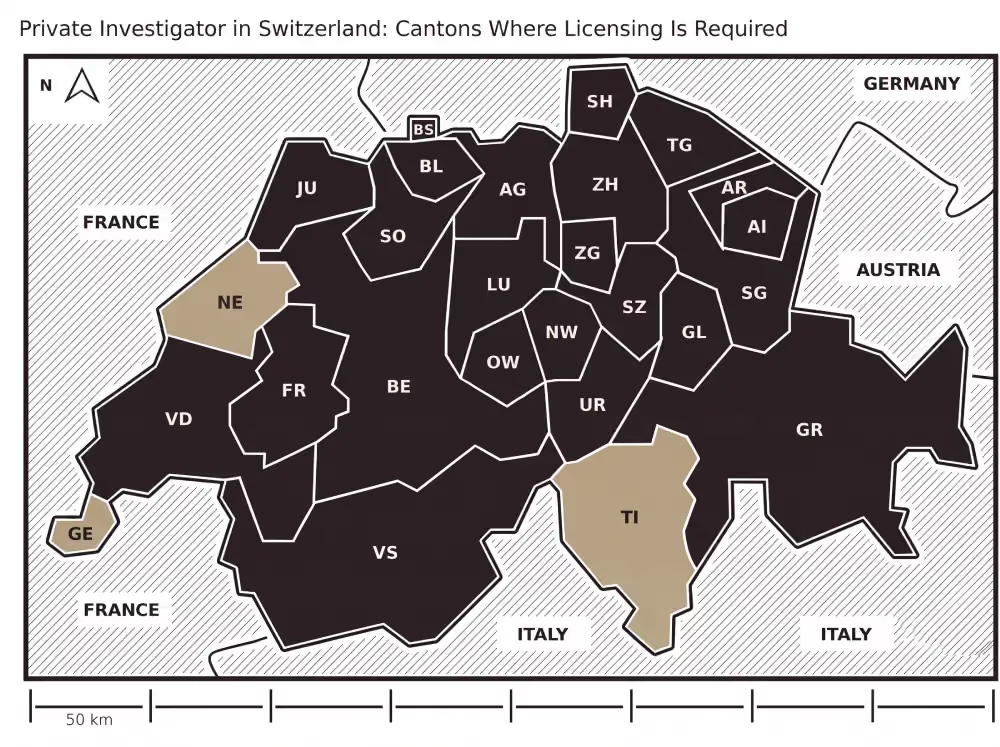
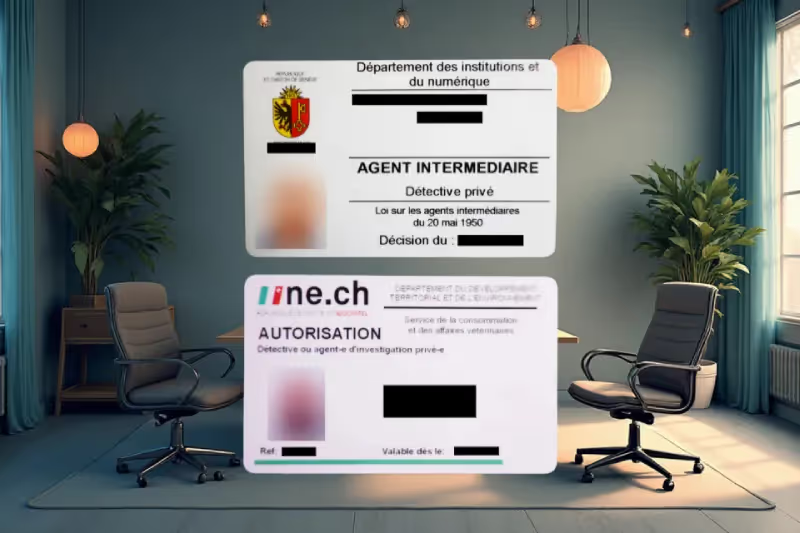
In these cantons, a private investigator may not operate legally without first obtaining authorization from the competent authorities and being listed in an official register. This authorization results in the issuance of a professional license card, certifying that the investigator meets the required legal, administrative, and integrity standards. Any investigation conducted without such authorization exposes not only the professional, but also the client, to significant legal risks, particularly regarding the admissibility of evidence.
Regulatory differences between cantons are therefore substantial. In Geneva, the profession is strictly governed by the Law on Intermediary Agents (LAInt) and is subject to oversight by cantonal authorities. Comparable regulations exist in Neuchâtel and Ticino. However, in the other Swiss cantons, the private investigator profession is not subject to a licensing requirement, which makes prior verification all the more essential before any engagement.
It is therefore crucial that any private investigator conducting an investigation in a regulated canton be properly licensed in that specific canton, regardless of their place of residence or the registered office of their agency.
By way of example, AGOP holds the official authorizations required in both the Canton of Geneva and the Canton of Neuchâtel, allowing it to operate legally in those jurisdictions and to produce findings that comply with the requirements of the competent authorities.
Before taking any action, familiarizing oneself with the legal framework applicable in the relevant canton and verifying the private investigator’s authorization are essential steps to ensure the legality of the investigation and the validity of the evidence collected.
Choosing a private investigator in Geneva is not limited to a simple online search or a question of fees. It is a sensitive process involving significant personal, legal, and sometimes financial stakes. Certain criteria must be verified before any decision is made.
Before entrusting a mission to a private investigator, several checks are essential.
First and foremost, it is necessary to ensure that the professional is officially authorized to operate in the Canton of Geneva. This authorization is issued by BASPE and appears on the official list of intermediary agents. A private investigator who is not listed is operating illegally, and any evidence they collect may be unusable.
Finally, no investigation should begin without the prior signing of a written mandate. This document precisely defines the scope of the assignment, its legal framework, the limits of the intervention, the fees, and the respective obligations of each party. Engaging a private investigator without a formal mandate exposes the client to unnecessary legal risks.
Contrary to a common misconception, the presence of a physical office is not an absolute criterion for assessing the seriousness or competence of a private investigator.
An office may indeed be a sign of stability and structure, particularly for certain established agencies. However, the absence of an office in no way indicates a lack of professionalism. The private investigator profession is, above all, fieldwork: surveillance, tailing, travel, observation, and discreet interventions account for the majority of the work.
Many investigators therefore favor meetings in neutral and discreet locations, selected according to the context and the client’s situation. This approach helps avoid a prospective client being seen near a private investigation agency, which could pose confidentiality risks.
Moreover, some professionals choose to invest in high-performance equipment, appropriate human resources, and strong operational availability rather than in fixed costs associated with maintaining a permanent office that is rarely used. This type of organization can be particularly effective, especially in sensitive cases.
When choosing a private investigator, caution is required when faced with overly attractive promises and certain forms of online communication. A highly polished visual identity or an excessively assertive discourse does not, in itself, constitute a guarantee of seriousness or competence.
Conversely, a neglected or poorly executed visual identity may also raise questions. The care given to presentation often reflects the level of professional standards applied, particularly in report writing and the quality of documents delivered to the client. A minimum level of rigor and visual consistency therefore remains essential, without becoming a commercial argument in itself.
Furthermore, caution is warranted regarding promises of guaranteed results or advertised success rates, which have no objective value in a profession where each situation is unique and depends on many factors beyond the investigator’s control. A serious private investigator can never guarantee an outcome, but only the means employed, the methodology applied, and strict compliance with the legal framework.
The issue of online client reviews also deserves special attention. Unlike other sectors, the private investigation profession generates very few genuine public testimonials. Why? Because the vast majority of clients wish to preserve their anonymity and discretion, which is perfectly understandable given the sensitive nature of the matters handled.
As such, the presence of a large number of anonymous, overly flattering, or standardized reviews should invite caution. These reviews are often impossible to verify and do not necessarily reflect the reality of the work performed. This level of vigilance should, moreover, apply to all websites consulted during your research.
By contrast, feedback from professionals - lawyers, insurers, colleagues, or institutional partners - may serve as more reliable indicators. Such feedback generally reflects real collaboration.
Absolute confidentiality is a fundamental pillar of the private investigator profession. The professional is bound by professional secrecy and must ensure the protection of all information entrusted by the client. Communications, collected data, and investigation results must be handled in strict compliance with Swiss legislation, particularly with regard to data protection and respect for privacy.
Conversely, attempts at “do-it-yourself” approaches - amateur surveillance, digital spying, or improvised tailing - directly expose the client to criminal risks and the total invalidation of any evidence obtained. Engaging a licensed private investigator makes it possible to avoid such pitfalls by relying on a clear legal framework and professional methods.
Simply consult the official list maintained by BASPE (Brigade of Weapons, Private Security and Explosives). Only private investigators or agencies listed there are legally authorized to operate in the Canton of Geneva.
No. There is no mandatory federal training requirement in Switzerland. However, a cantonal authorization is mandatory in Geneva and is issued following a strict review of the applicant’s integrity, professional background, and administrative situation.
The activities of private investigators are supervised by BASPE, under the authority of the Geneva Cantonal Police. BASPE oversees authorizations, conducts inspections, and may revoke an authorization in the event of non-compliance.
Yes, but only in compliance with the legislation applicable in the canton concerned. If a canton requires a specific authorization (such as Geneva, Neuchâtel, or Ticino), the investigator must also be licensed there in order to operate legally.
AGOP is a Swiss private investigation agency based in Geneva.


.svg)