
Préférences
By clicking “Accept all cookies”, you agree to the storing of cookies on your device to enhance site navigation, analyze site usage, and assist in our marketing efforts, as outlined in our Privacy Policy.


By clicking “Accept all cookies”, you agree to the storing of cookies on your device to enhance site navigation, analyze site usage, and assist in our marketing efforts, as outlined in our Privacy Policy.
December 22nd, 2025
Your favorite apps may be tracking your movements more closely than you realize.
Mobile applications are now an integral part of everyday life. Classified ads, games, weather apps, and online marketplaces accompany users at every moment. Yet behind this apparent convenience lies a more discreet reality: many of these digital tools collect and share highly precise location data, often without users fully understanding the extent of this tracking.
Digital surveillance refers to the collection and analysis of personal data - particularly location data - through mobile applications and connected devices. While this data is primarily used for targeted advertising, it is also part of a complex and largely opaque ecosystem involving multiple intermediaries.
An investigation published by the French newspaper Le Monde, in collaboration with partner outlets such as Netzpolitik, recently highlighted the scale of these practices. Their findings show how data from widely used consumer apps can be leveraged to accurately reconstruct the movements and habits of millions of individuals.
In many cases, users themselves authorize access to their location when installing an app, without fully grasping the long-term consequences of that choice. Some data continues to be collected in the background, even when the app is no longer actively used. At this point, the issue extends far beyond advertising and raises serious concerns related to privacy and personal security.
Every interaction with a mobile application generates data. Each time an app is opened, certain information may be recorded, such as geographic location, time of access, or duration of use. This applies not only to social or dating apps, but also to mobile games and everyday utility services.
Geolocation plays a central role in this process. Frequently presented as essential to proper functionality, location access is in fact one of the most valuable data sources for digital market players.
Access to location data is often granted with little reflection. Once collected, this data is shared with specialized intermediaries known as data brokers, whose business model revolves around analyzing and reselling personal information.
By aggregating location data over time, these brokers are able to build detailed behavioral profiles. They can identify recurring routes, determine a user’s home or workplace, and analyze patterns related to visits to stores or public places. In this context, geolocation becomes a key component of the advertising value chain.

Location tracking does not rely solely on GPS. Even when GPS is disabled, IP addresses allow for approximate localization with each internet connection. Additional signals are generated by sensors embedded in smartphones and connected devices, which continuously transmit information.
Taken together, these signals produce massive volumes of data. Every day, millions of location points are generated, analyzed, and stored—often without users being aware of the scale of this collection.
Even without activating GPS, apps continue to collect information. Your IP address reveals your approximate location each time you connect to the internet. Sensors embedded in everyday devices—such as smartwatches—also transmit data, sometimes without your explicit awareness.
Geolocation data does more than indicate a position at a given moment. When analyzed over time, it allows for the reconstruction of highly detailed movement patterns and lifestyle habits.
Successive GPS points reveal recurring routes. A home can be identified through consistent nighttime presence, while a workplace appears through regular weekday movements. Weekend locations, departure times, and return schedules also become predictable.
Such information may reveal sensitive aspects of private life, including religious beliefs, sexual orientation, political opinions, family circumstances, or health-related patterns. In some cases, the precision of location technologies makes it possible to identify a specific floor or a very limited area within a building.
When misused or exploited in an intrusive manner, this type of digital tracking can also contribute to targeted harassment - an issue we explore in greater depth in our article dedicated to stalking.
Geolocation data is not collected exclusively by specialized applications. Numerous everyday apps appear in databases maintained by both the U.S.-based Datastream Group and the company Gravy Analytics, illustrating the scale of this phenomenon.
Among them is Leboncoin, one of the most widely used digital platforms in France, with over 12 million monthly visitors. Analyzed data shows that the app collects and shares highly precise location information: more than 170,000 advertising identifiers linked to Leboncoin were identified in a single data sample. In some cases, this level of precision makes it easy to identify a user’s home or regularly visited locations.
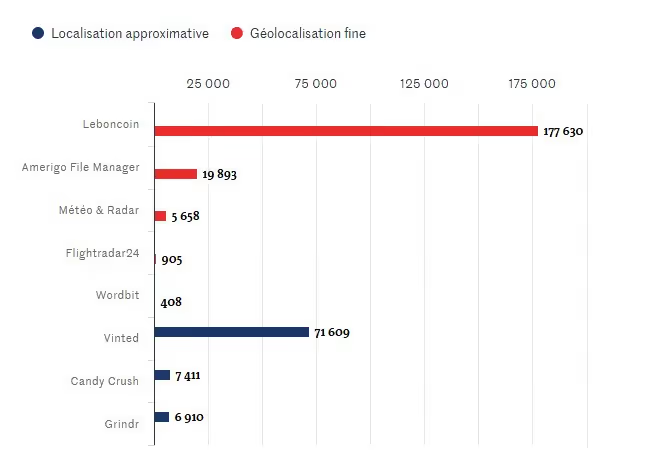
Leboncoin and Vinted thus emerge as significant contributors to personal data collection. The analyzed datasets also reveal the presence of numerous popular apps from a wide range of sectors, including classifieds and resale platforms, weather services, mobile games, and dating apps.
Weather services, often free and widely used, are particularly important sources of advertising data. Apps such as *Météo & Radar* rank among the most active in this area. Other well-known names include Vinted, Grindr, Candy Crush, and even flight-tracking services—illustrating how pervasive and largely invisible this data collection has become.
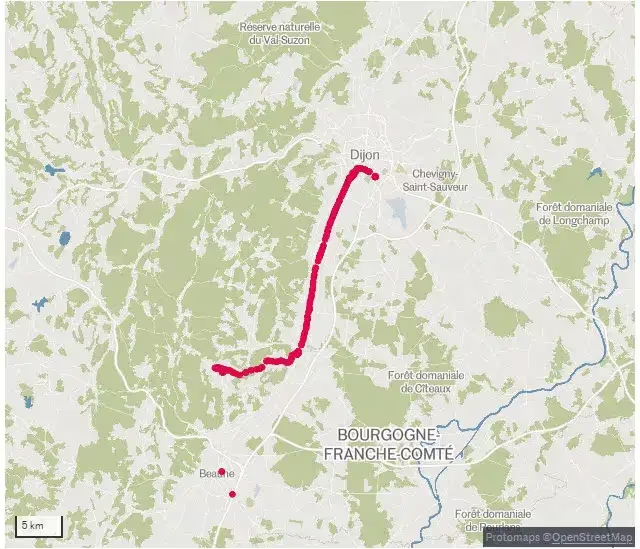
In many cases, location data allows for the full reconstruction of a user’s movements. Routes can be tracked with remarkable precision, such as between Nuits-Saint-Georges and Dijon in the Côte-d’Or region.
Although this data is associated with advertising identifiers that are supposedly anonymous, analysis reveals the locations most frequently visited by a single individual. This makes it possible to identify a home or habitual residence, as shown in an example located in a village in Morbihan.
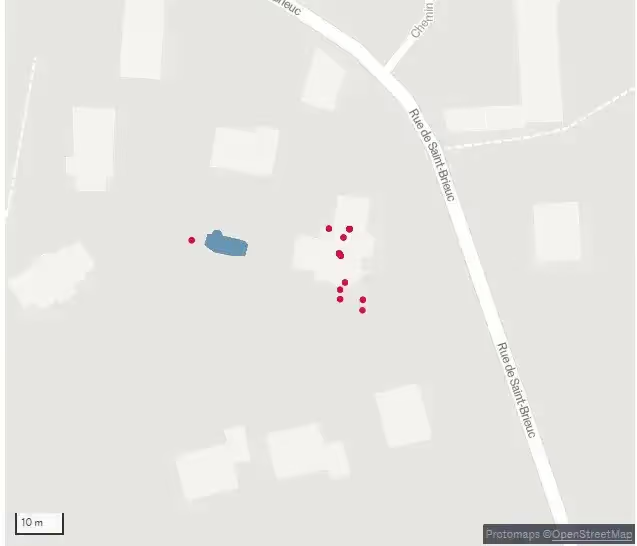
Location data also makes it possible to monitor movement within a defined perimeter. In a visualization of the École Polytechnique campus in Paris-Saclay, each color corresponds to a distinct advertising identifier, revealing the density and repetition of presence within a specific public space.


While advertising remains the primary purpose of this data collection, it is far from the only one. Once aggregated, data can be resold to other actors, sometimes without the user ever being informed.
Data brokers occupy a central position within this ecosystem. They purchase, enrich, and redistribute databases containing millions of advertising identifiers. App publishers do not always control how this data is ultimately used, contributing to a high level of opacity.
Such datasets may also attract intelligence actors or be exploited for surveillance purposes, particularly when they originate from leaks or publicly accessible databases.
The uncontrolled circulation of location data exposes individuals to multiple risks. Identity theft, excessive profiling, and unwanted surveillance are among the most significant threats. In the event of a data breach or cyberattack, this information may be exploited for fraud, blackmail, or impersonation.
Beyond individual harm, widespread digital surveillance raises broader concerns about fundamental freedoms. The possibility of being continuously tracked may discourage certain behaviors and ultimately limit freedom of expression.
In the face of these practices, understanding how data collection works remains the most effective form of protection. Regularly reviewing app permissions, limiting access to geolocation when it is not strictly necessary, and reading privacy policies are simple yet effective measures.
Digital security does not rely solely on technical tools. It also depends on everyday habits and informed decisions that are accessible to everyone.
Digital surveillance has become embedded in the everyday operation of mobile applications. Behind free access and ease of use lies an economic model built on the collection and monetization of personal data.
Movements, habits, and frequently visited locations are transformed into exploitable information within a complex and opaque market. The issues raised by this form of surveillance directly affect personal privacy and call for increased vigilance.
Understanding how these mechanisms operate enables more informed choices between technological convenience and the protection of personal privacy. Ultimately, the balance remains in the hands of users.
AGOP is a Swiss private investigation agency based in Geneva.


.svg)